
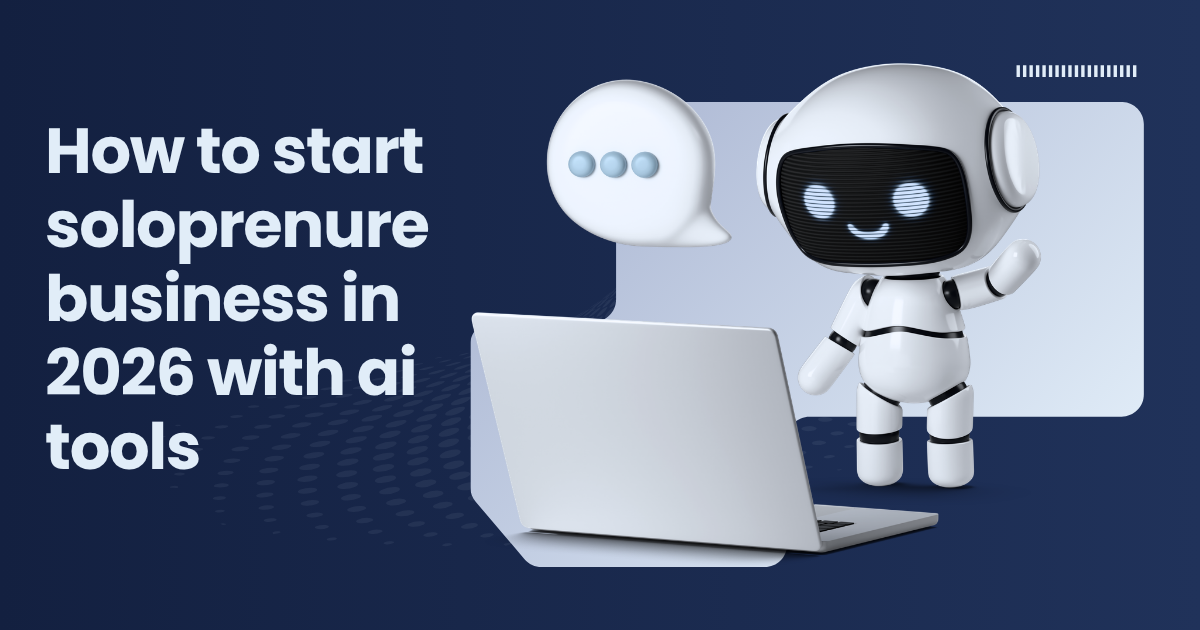
The Rise of the AI-Enhanced Individual: Starting Your Solopreneur Journey in 2026
The year 2026 marks a historic pivot in the global economy. We have moved past the era of "AI as a novelty" and into the era of AI as an operating system. For the solopreneur, this means the traditional barriers to entry—massive capital, a large team, and specialized technical skills—have effectively crumbled. With the rise of the best AI tools for marketing, even individuals with minimal resources can now build powerful, scalable brands from scratch.
Today, a "company of one" can operate with the efficiency, output, and sophisticated branding of a twenty-person agency. If you’ve been waiting for a sign to launch that venture, this is it. Here is your comprehensive blueprint for building a solopreneur business in 2026.
1. The Mindset Shift: From "Doer" to "Director"
In 2026, the most successful solopreneurs aren't just experts in their craft; they are expert orchestrators. Your value no longer lies in performing repetitive tasks, but in your ability to direct AI agents to execute your vision.
Human-Centric Value: Focus on what AI cannot replicate—empathy, complex ethics, personal branding, and high-level strategy.
The 90/10 Rule: Aim to have AI handle 90% of the execution (coding, drafting, data analysis) while you provide the 10% of critical human oversight and creative direction.
2. Identifying Your High-Leverage Niche
Market saturation is real, but personalized depth is undersupplied. In 2026, generalists are being replaced by hyper-niche experts who use AI to scale their specific knowledge.
To choose the right niche, start by finding the intersection between your unique hobby or past professional experience and a cutting-edge AI application. You should also focus on solving real problems. Use AI trend analysis tools to identify micro-pain points in emerging industries and position yourself as the solution provider.
3. Building Your AI Tech Stack (The 2026 Essentials)
You don’t need a massive budget; you need smart integration. The modular stack is the key to efficiency.
For strategy, reasoning models can replace the need for junior consultants by helping you make data-driven decisions. In operations, autonomous AI agents can manage repetitive tasks like scheduling, research, and communication. For content creation, multimodal generative AI can produce blogs, videos, graphics, and more—eliminating the need for large creative teams.
In sales, AI-powered CRM and outreach tools can handle lead generation and nurturing. On the technical side, no-code and AI-assisted development platforms allow you to build websites and apps without deep programming knowledge.
Using the best AI tools for marketing, solopreneurs can automate branding, outreach, and content creation without needing a full team.
4. Phase I: Market Validation (Weeks 1–2)
Don’t build in a vacuum. Use AI to validate your idea before investing time or money.
Create synthetic personas by generating AI-based customer profiles and test your idea against their preferences. Use predictive analytics to analyze search trends, social signals, and demand patterns. You can also perform a "vaporware" test by building a simple landing page and measuring user interest before fully launching your product or service.
5. Phase II: Creating Your Visual & Digital Identity
Branding in 2026 is no longer static—it’s dynamic and evolving.
With generative branding tools, you can create a complete brand identity including logos, color schemes, tone of voice, and visual assets. AI ensures consistency across all platforms.
Building a website is now easier than ever. Instead of coding, you can simply describe your requirements and AI will generate a fully functional, optimized website. Make sure your website is accessible not only to users but also to AI assistants that summarize and recommend services.
6. Phase III: The Content Engine
Content remains the backbone of growth, but now it is amplified through AI.
Start by creating one high-quality piece of content, such as a blog or video. Then use AI to repurpose it into multiple formats like social media posts, short-form videos, newsletters, and podcasts.
While AI handles content production, your role is to add the human touch. Engage with your audience in comments, reply to messages, and build relationships that foster trust and loyalty.
7. Phase IV: Sales and Automation
Sales in 2026 is driven by intelligent automation systems.
AI can personalize website experiences for each visitor, adapting content based on their behavior and background. For outbound strategies, AI can analyze user data and craft highly personalized messages that feel authentic and relevant.
With the best AI tools for marketing, your entire sales funnel can run continuously—engaging leads, nurturing relationships, and converting prospects into customers without constant manual effort.
8. Managing Finances and Legal in the AI Era
Managing finances and legal tasks is no longer overwhelming.
AI-powered bookkeeping tools can automatically track expenses, categorize transactions, and even predict tax liabilities. They also suggest deductions you might miss.
For legal work, AI can generate contracts, agreements, and documents quickly. While it’s still wise to get a professional review for critical matters, AI significantly reduces the time and cost involved.
9. The Challenge: Avoiding the "Uncanny Valley" of Business
With increased automation, there is a risk of your business feeling impersonal.
To avoid this, make sure you remain visible as the face of your brand. Show your personality through videos, posts, and communication. Be transparent about how you use AI in your business. Most importantly, focus on building a community where people feel connected and valued.
10. Scaling Without Hiring
Scaling your business no longer requires hiring a large team.
Instead, identify bottlenecks in your workflow and build custom AI solutions to handle those tasks using the best AI tools for marketing. Integrate your tools so that data flows seamlessly between systems, improving efficiency and reducing manual work.
The goal is to create a high-revenue, one-person business powered by smart systems rather than a large workforce.
Conclusion: Your Time is Now
In 2026, technology is no longer the limitation—your imagination and discipline are. Starting a solopreneur business today requires a clear vision and the willingness to leverage AI effectively.
You don’t need a co-founder. You don’t need funding. You just need a solid plan, consistency, and adaptability.
The future of work isn’t a crowded office—it’s one individual empowered by intelligent systems, building something extraordinary.
More from our blog
See all posts






Recent Posts
- How to start solopreneur business in 2026 with AI tools? April 25, 2026
- Identify Research Gaps April 1, 2026
- Trending PhD Research Topics by Subject April 1, 2026